Wednesday, September 27, 2006
Equal Treatment of Cultures and the Limits of Postmodern Liberalism*
available for free download from here


Friday, September 22, 2006
Benedict and the value gap
"Pope Benedict XVI's Regensburg speech gives no rational ground for the
commotion now being stirred up from Pakistan to Europe. In our
globalised, individualised and thoroughly economicised world, the
purely technical use of reason threatens to bring about a value gap.
That the Pope should try to close this gap with religious means may
not have proved effective, yet this is exactly where all believers
should find common ground."
by Stephan Hebel
full here
Note: link now fixed.
commotion now being stirred up from Pakistan to Europe. In our
globalised, individualised and thoroughly economicised world, the
purely technical use of reason threatens to bring about a value gap.
That the Pope should try to close this gap with religious means may
not have proved effective, yet this is exactly where all believers
should find common ground."
by Stephan Hebel
full here
Note: link now fixed.
Tuesday, September 05, 2006
A new book by Professor Maeve Cooke
Re-Presenting the Good Society
Contemporary critical social theories face the question of how to justify the ideas of the good society that guide their critical analyses. Traditionally, these more or less determinate ideas of the good society were held to be independent of their specific sociocultural context and historical epoch. Today, such a concept of context-transcending validity is not easy to defend; the "linguistic turn" of Western philosophy signals the widespread acceptance of the view that ideas of knowledge and validity are always mediated linguistically and that language is conditioned by history and context. In Re-Presenting the Good Society, Maeve Cooke addresses the justificatory dilemma facing critical social theories: how to maintain an idea of context-transcending validity without violating anti-authoritarian impulses. In doing so she not only clarifies the issues and positions taken by other theorists--including Richard Rorty, Jürgen Habermas, Axel Honneth, and Judith Butler--but also offers her own original and thought-provoking analysis of context-transcending validity.
Because the tension between an anti-authoritarian impulse and a guiding idea of context-transcending validity is today an integral part of critical social theory, Cooke argues that it should be negotiated rather than eliminated. Her proposal for a concept of context-transcending validity has as its central claim that we should conceive of the good society as re-presented in particular constitutively inadequate representations of it. These re-presentations are, Cooke argues provocatively, regulative ideas that have an imaginary, fictive character.
from here
For contents and to download sample chapters go here
Reference courtesy of Gary.
Contemporary critical social theories face the question of how to justify the ideas of the good society that guide their critical analyses. Traditionally, these more or less determinate ideas of the good society were held to be independent of their specific sociocultural context and historical epoch. Today, such a concept of context-transcending validity is not easy to defend; the "linguistic turn" of Western philosophy signals the widespread acceptance of the view that ideas of knowledge and validity are always mediated linguistically and that language is conditioned by history and context. In Re-Presenting the Good Society, Maeve Cooke addresses the justificatory dilemma facing critical social theories: how to maintain an idea of context-transcending validity without violating anti-authoritarian impulses. In doing so she not only clarifies the issues and positions taken by other theorists--including Richard Rorty, Jürgen Habermas, Axel Honneth, and Judith Butler--but also offers her own original and thought-provoking analysis of context-transcending validity.
Because the tension between an anti-authoritarian impulse and a guiding idea of context-transcending validity is today an integral part of critical social theory, Cooke argues that it should be negotiated rather than eliminated. Her proposal for a concept of context-transcending validity has as its central claim that we should conceive of the good society as re-presented in particular constitutively inadequate representations of it. These re-presentations are, Cooke argues provocatively, regulative ideas that have an imaginary, fictive character.
from here
For contents and to download sample chapters go here
Reference courtesy of Gary.
Tuesday, August 29, 2006
“Critique” immanent in “practice”: New Frankfurt School and American pragmatism
Abstract As a result of a new understanding of the relation between theory and practice, the “New Frankfurt School,” with Jürgen Habermas as its major representative, highly values the philosophical tradition of American pragmatism, in contrast to the first generation Critical Theorists represented by Max Horkheimer. In Habermas, the idea of “critique” is, both substantially and methodologically, closely connected with the idea of “praxis” in the following senses: communicative action, rational argumentation, public discussion and political culture. “Critique” is thus found to be immanent in “praxis”; or, a la Horkheimer, pragmatism turns out to be a “critical philosophical analysis” without “falling back upon objective reason and mythology.”
from here
from here
Wednesday, August 16, 2006
On Dialogue
"Under a rather humble title Dmitri Nikulin offers in this book a substantial account of what dialogue is and involves. He offers a detailed description and discussion of the different mechanisms of dialogue, its categories and constituents, as well as a useful and instructive review of the different uses of dialogue from Plato to more contemporary authors. At the same time he makes a striking ontological claim regarding the role and function of dialogue, arguing that to be means to be in dialogue.
This ontological claim is a generalization of the views of Bakhtin on literature. Bakhtin was among the first to bring to the fore the dialogicity of what appeared to be monological discourse. In his studies of Rabelais and Dostoevsky Bakhtin showed how novels are polyphonic, how a voice is permeated by other voices at the very moment it claims to be its own. He dedicated several works to the logic particular to dialogue and came to see dialogue as a literary genre. Nikulin wants to extend this view of dialogue and polyphony beyond the boundaries of literature and generalize the inner workings of a text to being: being is, for Nikulin, dialogical. Most of the book is devoted to building and defending this ontological claim that dialogue is the conditio humana."
Continue reading
This ontological claim is a generalization of the views of Bakhtin on literature. Bakhtin was among the first to bring to the fore the dialogicity of what appeared to be monological discourse. In his studies of Rabelais and Dostoevsky Bakhtin showed how novels are polyphonic, how a voice is permeated by other voices at the very moment it claims to be its own. He dedicated several works to the logic particular to dialogue and came to see dialogue as a literary genre. Nikulin wants to extend this view of dialogue and polyphony beyond the boundaries of literature and generalize the inner workings of a text to being: being is, for Nikulin, dialogical. Most of the book is devoted to building and defending this ontological claim that dialogue is the conditio humana."
Continue reading
Saturday, July 29, 2006
Tuesday, July 25, 2006
John McDowell: Reason and Nature available online!
to my utter surprise! Go here to download and enjoy!
Habermas' 'weak' naturalism and McDowell's non reductive naturalism
The following passage from McDowell helped me a lot in understanding Habermas' weak naturalism. I thought I would share it here:
“Acquiring command of a language, which is coming to inhabit the logical space of reasons, is acquiring a second nature. Given that the space of reasons is special in the way Sellars urges, ideas of phenomena that are manifestations of a second nature acquired in acquiring command of a language do not, as such, fit in the logical space of natural-scientific understanding. But there is no reason why that should rule out seeing those phenomena as manifestations of nature, since the nature in question can be a second nature. Actualizations of conceptual capacities, which as such belong in the logical space of reasons, can be natural in a different sense the one that figures in admittedly well-drawn contrast with the logical space of reasons.” Experiencing the World, p. 7, in John McDowell: Reason and Nature
“Acquiring command of a language, which is coming to inhabit the logical space of reasons, is acquiring a second nature. Given that the space of reasons is special in the way Sellars urges, ideas of phenomena that are manifestations of a second nature acquired in acquiring command of a language do not, as such, fit in the logical space of natural-scientific understanding. But there is no reason why that should rule out seeing those phenomena as manifestations of nature, since the nature in question can be a second nature. Actualizations of conceptual capacities, which as such belong in the logical space of reasons, can be natural in a different sense the one that figures in admittedly well-drawn contrast with the logical space of reasons.” Experiencing the World, p. 7, in John McDowell: Reason and Nature
Wednesday, July 19, 2006
Introduction to my dissertation
Note: This is a draft of introduction to my thesis. I have (for the time being) removed all foot notes and emphases.
Habermas’ work from the start has two seemingly contradictory aspects to it. On the one hand he emphasises the natural origin of human beings, their knowledge and reason and adopts a position that though avoiding all kinds of reductionism can be termed as materialist, realist and naturalist. On the other hand Habermas also aims to preserve the distinction between human beings and their surroundings by emphasising the transcending powers of reason and thought.
Habermas’ first mature philosophical work Knowledge and Human Interests starts with a Hegelian note endorsing the essence of Hegel’s critique of Kant. In its claim that knowledge is based on and founded on human interests, the interests that connect human beings to nature and the material world, it is a thoroughly anti Kantian and Marxist-Hegelian work. Habermas’ later weak naturalism is already present in KHI. Habermas’ Frankfurt inaugural lecture on which KHI is based contains a scathing critique of the notion of pure theory divorced from practice. The lecture shows the deep influence of Heidegger. Habermas’ critique of pure theory emanates from the deep anti intellectualism whose roots go back not only to Heidegger’s Being and Time but also to the Marxist and Frankfurt schools’ distrust for pure theory.
In Habermas’ later writings the above results in Habermas’ adoption of a full blown pragmatism and a conception of knowledge that recognises the epistemic value of practice and action.
Hegelian themes are also all pervasive in Habermas’ later work. Habermas’ theory of communicative action is based on the insight that our explicit contact with our fellow beings and the world around us is based on a prior and implicit contact with them. The theory of communicative action gives centrality to the embedded and social character of the process of reaching understanding. The subjects of communicative action are thoroughly socialised and embedded subjects. The theory of communicative action also emphasises the importance of the process as against the product of that process in correctly analysing rational activity.
Continue Reading
Habermas’ work from the start has two seemingly contradictory aspects to it. On the one hand he emphasises the natural origin of human beings, their knowledge and reason and adopts a position that though avoiding all kinds of reductionism can be termed as materialist, realist and naturalist. On the other hand Habermas also aims to preserve the distinction between human beings and their surroundings by emphasising the transcending powers of reason and thought.
Habermas’ first mature philosophical work Knowledge and Human Interests starts with a Hegelian note endorsing the essence of Hegel’s critique of Kant. In its claim that knowledge is based on and founded on human interests, the interests that connect human beings to nature and the material world, it is a thoroughly anti Kantian and Marxist-Hegelian work. Habermas’ later weak naturalism is already present in KHI. Habermas’ Frankfurt inaugural lecture on which KHI is based contains a scathing critique of the notion of pure theory divorced from practice. The lecture shows the deep influence of Heidegger. Habermas’ critique of pure theory emanates from the deep anti intellectualism whose roots go back not only to Heidegger’s Being and Time but also to the Marxist and Frankfurt schools’ distrust for pure theory.
In Habermas’ later writings the above results in Habermas’ adoption of a full blown pragmatism and a conception of knowledge that recognises the epistemic value of practice and action.
Hegelian themes are also all pervasive in Habermas’ later work. Habermas’ theory of communicative action is based on the insight that our explicit contact with our fellow beings and the world around us is based on a prior and implicit contact with them. The theory of communicative action gives centrality to the embedded and social character of the process of reaching understanding. The subjects of communicative action are thoroughly socialised and embedded subjects. The theory of communicative action also emphasises the importance of the process as against the product of that process in correctly analysing rational activity.
Continue Reading
Saturday, July 15, 2006
A new book on Habermas
Note: moving up due to a new comment
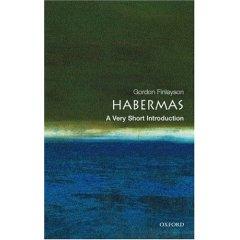
I have not yet received my copy but this should be wroth reading. It would be interesting to see whether a successful "very short" introduction can be written of Habermas' work.
Habermas: A Very Short Introduction
by James Gordon Finlayson
Here is a description of the book from OUP
"Provides a completely up to date and much-needed entry into the long and forbiddingly technical works of the most influential German philosopher alive today
Covers Habermas's influence on a wide variety of fields, including philosophy, political and social theory, cultural studies, sociology, and literary studies
Explains how Habermas's ideas are applied to present day social and political situations.
Unlike other writings on Habermas, this explains his intellectual framework and technical vocabulary rather than simply adopting it
This book gives a clear and readable overview of the philosophical work of Jürgen Habermas, the most influential German philosopher alive today, who has commented widely on subjects such as Marxism, the importance and effectiveness of communication, the reunification of Germany, and the European Union. Gordon Finlayson provides readers with a clear and readable overview of Habermas's forbiddingly complex philosophy using concrete examples and accessible language. He then goes on to analyse both the theoretical underpinnings of Habermas's social theory, and its more concrete applications in the fields of ethics, politics, and law; and concludes with an examination how Habermas's social and political theory informs his writing on contemporary, political, and social problems."
Contents
Preface: Who is Jürgen Habermas
1 Habermas and Frankfurt School Critical Theory
2 Habermas's New Approach to Social Theory
3 The Pragmatic Meaning Programme
4 The Programme of Social Theory
5 Habermas's Theory of Modernity
6 Discourse Ethics I: The Discourse Theory of Morality
7 Discourse Ethics II: Ethical Discourse and the Political Turn
8 Politics, Democracy, and Law
9 Politics Beyond The Bounds Of The Nation Alone
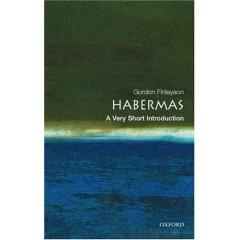
I have not yet received my copy but this should be wroth reading. It would be interesting to see whether a successful "very short" introduction can be written of Habermas' work.
Habermas: A Very Short Introduction
by James Gordon Finlayson
Here is a description of the book from OUP
"Provides a completely up to date and much-needed entry into the long and forbiddingly technical works of the most influential German philosopher alive today
Covers Habermas's influence on a wide variety of fields, including philosophy, political and social theory, cultural studies, sociology, and literary studies
Explains how Habermas's ideas are applied to present day social and political situations.
Unlike other writings on Habermas, this explains his intellectual framework and technical vocabulary rather than simply adopting it
This book gives a clear and readable overview of the philosophical work of Jürgen Habermas, the most influential German philosopher alive today, who has commented widely on subjects such as Marxism, the importance and effectiveness of communication, the reunification of Germany, and the European Union. Gordon Finlayson provides readers with a clear and readable overview of Habermas's forbiddingly complex philosophy using concrete examples and accessible language. He then goes on to analyse both the theoretical underpinnings of Habermas's social theory, and its more concrete applications in the fields of ethics, politics, and law; and concludes with an examination how Habermas's social and political theory informs his writing on contemporary, political, and social problems."
Contents
Preface: Who is Jürgen Habermas
1 Habermas and Frankfurt School Critical Theory
2 Habermas's New Approach to Social Theory
3 The Pragmatic Meaning Programme
4 The Programme of Social Theory
5 Habermas's Theory of Modernity
6 Discourse Ethics I: The Discourse Theory of Morality
7 Discourse Ethics II: Ethical Discourse and the Political Turn
8 Politics, Democracy, and Law
9 Politics Beyond The Bounds Of The Nation Alone
Wednesday, July 12, 2006
Habermas, intellectuals and the internet
Note: Bringing forward due to new comments
An Austrian paper has printed the first part (second part is here)of an acceptance speech by German philosopher Jürgen Habermas for the Bruno Kreisky Prize for promoting human rights (part II will follow tomorrow). Habermas discusses the declining prominence of intellectuals through television and the Internet: "On the one hand, the communication shift from books and the printed press to the television and the Internet has brought about an unimagined broadening of the media sphere, and an unprecedented consolidation of communication networks. Intellectuals used to swim around in the public sphere like fish in water, but this environment has become ever more inclusive, while the exchange of ideas has become more intensive than ever. But on the other hand the intellectuals seem to be suffocating from the excess of this vitalising element, as if they were overdosing. The blessing seems to have become a curse. I see the reasons for that in the de-formalisation of the public sphere, and in the de-differentiation of the respective roles."
from here
An Austrian paper has printed the first part (second part is here)of an acceptance speech by German philosopher Jürgen Habermas for the Bruno Kreisky Prize for promoting human rights (part II will follow tomorrow). Habermas discusses the declining prominence of intellectuals through television and the Internet: "On the one hand, the communication shift from books and the printed press to the television and the Internet has brought about an unimagined broadening of the media sphere, and an unprecedented consolidation of communication networks. Intellectuals used to swim around in the public sphere like fish in water, but this environment has become ever more inclusive, while the exchange of ideas has become more intensive than ever. But on the other hand the intellectuals seem to be suffocating from the excess of this vitalising element, as if they were overdosing. The blessing seems to have become a curse. I see the reasons for that in the de-formalisation of the public sphere, and in the de-differentiation of the respective roles."
from here
Tuesday, July 04, 2006
Critique Today
"What are the tasks and potentials of critical theory today? How should we critique the present? Critique Today brings together a variety of perspectives in critical social philosophy that question our social and historical constellation. It includes contributions by Genevieve Lloyd, Shane O’Neill, Paul Patton, Paul Redding, Emmanuel Renault, and Nicholas Smith, and examines critical intersections in the work of Jürgen Habermas, Axel Honneth, Pierre Bourdieu, Michel Foucault, and Giorgio Agamben. Critique Today aims to further the ongoing dialogue between German critical theory and French post-structuralism, explores the relationship between philosophy and social theory, and develops new approaches to Hegel and theories of recognition, the theme of social hope, and contemporary discussions of rights and power."
from here
from here
Thursday, June 29, 2006
Habermas' concept of 'transcendence from within": An interpretation
A revised version of my thesis abstract is posted below. I am looking for prospective examiners at this stage. Any suggestions welcome (leave as comment or email me, thanks).
Abstract
The dissertation is structured as an interpretation of Habermas’ concept of transcendence from within. The interpretation is focused on Habermas’ claim that his enterprise aims to go beyond transcendenceless empiricism and high flying idealism. Habermas has used the term transcendence from within increasingly in his recent writings. However there is no systematic analysis of the concept to be found in either primary or secondary literature. The present dissertation is meant to fill this gap.
The focus on the theme of transcendence from within can help us understand Habermas’ project as that of going beyond the dichotomy (but not the distinction) between detranscendentalisation and transcendentalism rather than treating it as a patchwork of the two themes.
The topic of transcendence from within has enormous significance for Habermas’ project as well as for general philosophical and cultural trends of our times. The theme of weak naturalism has surfaced with a new vigour in Habermas’ writings. He has consistently argued for a detranscendentalised reason that does not forget its ultimate roots in nature at large. However he has also intensified his crusade against strong naturalism which he sees as a threat to the Kantian tradition of autonomous thought, freedom and responsibility. In the context of his discussion of religion he has talked about going beyond two fundamentalisms, religious fundamentalism that does not take detranscendentalisation seriously, and scientism (which Habermas sees as the basis of strong naturalism) that is bent on sacrificing all traces of the transcending powers of reason. A systematic reconstruction of the concept of transcendence from within can provide the basis for understanding how Habermas aims to combine naturalism and detranscendentalisation with a firm belief in the transcending powers of reason and the possibility of free and autonomous thought.
The approach taken is to reconstruct Habermas’ conception of transcendence from within in detail. At the start a thesis is introduced that Habermas aims to preserve the overall continuity between human beings and their environment by adopting pragmatism and detranscendentalisation. However he also aims to preserve essential distinctions between human beings and their environment while upholding overall continuities between the two. Detranscendentalisation (far from being seen as the opposite of transcendentalism) is thus seen as the way to preserve the transcending powers of reason and preserve the distinctions essential to a transcendental idealism (such as the distinction between causality of nature and causality of law, unconditionality of rational claims etc.) without, however, espousing a two world metaphysics inherent in such an approach.
Although the dissertation is focused on a detailed reconstruction of Habermas’ conception of transcendence from within, in brief concluding comments I raise some doubts about Habermas’ approach in terms of its huge baggage of assumptions as well as in terms of its weakness in the face of its abandonment of the traditional conception of truth.
Abstract
The dissertation is structured as an interpretation of Habermas’ concept of transcendence from within. The interpretation is focused on Habermas’ claim that his enterprise aims to go beyond transcendenceless empiricism and high flying idealism. Habermas has used the term transcendence from within increasingly in his recent writings. However there is no systematic analysis of the concept to be found in either primary or secondary literature. The present dissertation is meant to fill this gap.
The focus on the theme of transcendence from within can help us understand Habermas’ project as that of going beyond the dichotomy (but not the distinction) between detranscendentalisation and transcendentalism rather than treating it as a patchwork of the two themes.
The topic of transcendence from within has enormous significance for Habermas’ project as well as for general philosophical and cultural trends of our times. The theme of weak naturalism has surfaced with a new vigour in Habermas’ writings. He has consistently argued for a detranscendentalised reason that does not forget its ultimate roots in nature at large. However he has also intensified his crusade against strong naturalism which he sees as a threat to the Kantian tradition of autonomous thought, freedom and responsibility. In the context of his discussion of religion he has talked about going beyond two fundamentalisms, religious fundamentalism that does not take detranscendentalisation seriously, and scientism (which Habermas sees as the basis of strong naturalism) that is bent on sacrificing all traces of the transcending powers of reason. A systematic reconstruction of the concept of transcendence from within can provide the basis for understanding how Habermas aims to combine naturalism and detranscendentalisation with a firm belief in the transcending powers of reason and the possibility of free and autonomous thought.
The approach taken is to reconstruct Habermas’ conception of transcendence from within in detail. At the start a thesis is introduced that Habermas aims to preserve the overall continuity between human beings and their environment by adopting pragmatism and detranscendentalisation. However he also aims to preserve essential distinctions between human beings and their environment while upholding overall continuities between the two. Detranscendentalisation (far from being seen as the opposite of transcendentalism) is thus seen as the way to preserve the transcending powers of reason and preserve the distinctions essential to a transcendental idealism (such as the distinction between causality of nature and causality of law, unconditionality of rational claims etc.) without, however, espousing a two world metaphysics inherent in such an approach.
Although the dissertation is focused on a detailed reconstruction of Habermas’ conception of transcendence from within, in brief concluding comments I raise some doubts about Habermas’ approach in terms of its huge baggage of assumptions as well as in terms of its weakness in the face of its abandonment of the traditional conception of truth.
Monday, June 26, 2006
A brief review of Zwischen Naturalismus und Religion. Philosophische Aufsätze (“Between Naturalism and Religion. Philosophical Essays”)
"Criticism of religion is nothing new. Since the Enlightenment call to “think for yourself,” religion has been criticised for being dogmatic, superstitious, unscientific and illusionary. And this has had real benefits.
A religion, like any comprehensive system of beliefs, needs rational critique if it is to avoid falling into ideological dogmatism. Rational critics have helped many religious believers to see that to have faith does not mean to be without doubt. A healthy faith does not think that it already has all the answers; it lives with the hope that its basic beliefs are true. Fundamentally, faith is an adventure of love guided by reason.
A recent book from the German philosopher of communication Jürgen Habermas, entitled Zwischen Naturalismus und Religion. Philosophische Aufsätze (“Between Naturalism and Religion. Philosophical Essays”) is interesting in this regard as it argues that the major intellectual challenge of our age is the need to move beyond the dogmatisms of both naturalism and religious fundamentalism.
The book starts with a fascinating account of Habermas’s own history of growing up in Nazi Germany during World War II. Surgery on his palate left him with serious communication difficulties and resulted in early experiences of being misunderstood by other children and rejected. These experiences also left him with a strong sense of the sociality of our human nature, of the fact that we are dependent upon one another in a very profound way. He notes that his theory of social communication is influenced by this as well as by the sense that something had gone tragically wrong with German democracy. As a result, the aim of his life’s work has been to develop an understanding of democracy that can protect itself from the dogmatisms of ideologies that unjustly exclude others and prevent real dialogue.
Turning his sights on naturalism, which he understands to be the belief that natural physico-chemical processes can explain everything, Habermas explores the example of some contemporary German neuro-scientists who have tried to explain human freedom as an illusion created by purely natural mechanisms. Despite a vast amount of philosophical critique of this reductionistic position since the nineteenth-century, they still present the human mind and freewill as being totally determined by physiological and biochemical processes.
Taking a Kantian line, Habermas understands freedom as the autonomous use of the will and not simply something determined by biology. An act is free, for Habermas, when the actor uses his or her will to bring about a purposeful action. When this is not the case, as in the situation of being externally determined, then we are not acting freely.
Habermas is not against naturalism per se; rather, he is against the tendency to make this naturalistic dogma into an unquestionable scientific worldview.
On the other side of this cultural tug-of-war, he considers the growth of religious fundamentalism and its political significance. While arguing against the exclusivist dogmatism of fundamentalist religious engagements in political life, he considers enlightened religions to offer important resources for the well-being of democracy. In fact, he notes that religions have often been trend-setters for human rights and for the emergence of modern democracy itself.
Contrary to a position which he held in his earlier days, he suggests that the secularist ideology of naturalism needs to be overcome if enlightened religions are to take their rightful place in the democratic debates of the modern world. This secularist worldview has, he argues, often unjustly eliminated religious voices from public debate and relegated them to the sidelines of irrationality and dogmatism. Yet, Habermas himself is somewhat unclear about this secularist position, since in parts of the book he continues to characterise religious conceptions of the good life as being essentially non-discursive and hence needing to be translated into a publicly accessible language for political use. Despite his attempt to find a way beyond naturalism and fundamentalism he still seems to find it difficult to avoid the Kantian reduction of religion to simply a motivating force for morality. Notwithstanding some excellent analysis of the dilemmas posed by the spread of scientific naturalism and religious fundamentalism, when it comes to religion, Habermas himself still seems to share some of the secularist ideology that he wants to criticise.
Nonetheless, this book is a reminder that if pluralistic societies are to move beyond the dogmatisms of both scientific naturalism and religious fundamentalism, all positions presented in democratic debate must be exposed to rational critique. Only through such critique can the dangers of ideological blindness be minimised and the resources offered by alternative positions be made available to our democracies. In the end it is reasoned argument which overcomes dogmatism, a position Habermas himself has defended with great skill and conviction all his life."
from here
Thanks to Gary for the link.
for further reviews of the book see here
A religion, like any comprehensive system of beliefs, needs rational critique if it is to avoid falling into ideological dogmatism. Rational critics have helped many religious believers to see that to have faith does not mean to be without doubt. A healthy faith does not think that it already has all the answers; it lives with the hope that its basic beliefs are true. Fundamentally, faith is an adventure of love guided by reason.
A recent book from the German philosopher of communication Jürgen Habermas, entitled Zwischen Naturalismus und Religion. Philosophische Aufsätze (“Between Naturalism and Religion. Philosophical Essays”) is interesting in this regard as it argues that the major intellectual challenge of our age is the need to move beyond the dogmatisms of both naturalism and religious fundamentalism.
The book starts with a fascinating account of Habermas’s own history of growing up in Nazi Germany during World War II. Surgery on his palate left him with serious communication difficulties and resulted in early experiences of being misunderstood by other children and rejected. These experiences also left him with a strong sense of the sociality of our human nature, of the fact that we are dependent upon one another in a very profound way. He notes that his theory of social communication is influenced by this as well as by the sense that something had gone tragically wrong with German democracy. As a result, the aim of his life’s work has been to develop an understanding of democracy that can protect itself from the dogmatisms of ideologies that unjustly exclude others and prevent real dialogue.
Turning his sights on naturalism, which he understands to be the belief that natural physico-chemical processes can explain everything, Habermas explores the example of some contemporary German neuro-scientists who have tried to explain human freedom as an illusion created by purely natural mechanisms. Despite a vast amount of philosophical critique of this reductionistic position since the nineteenth-century, they still present the human mind and freewill as being totally determined by physiological and biochemical processes.
Taking a Kantian line, Habermas understands freedom as the autonomous use of the will and not simply something determined by biology. An act is free, for Habermas, when the actor uses his or her will to bring about a purposeful action. When this is not the case, as in the situation of being externally determined, then we are not acting freely.
Habermas is not against naturalism per se; rather, he is against the tendency to make this naturalistic dogma into an unquestionable scientific worldview.
On the other side of this cultural tug-of-war, he considers the growth of religious fundamentalism and its political significance. While arguing against the exclusivist dogmatism of fundamentalist religious engagements in political life, he considers enlightened religions to offer important resources for the well-being of democracy. In fact, he notes that religions have often been trend-setters for human rights and for the emergence of modern democracy itself.
Contrary to a position which he held in his earlier days, he suggests that the secularist ideology of naturalism needs to be overcome if enlightened religions are to take their rightful place in the democratic debates of the modern world. This secularist worldview has, he argues, often unjustly eliminated religious voices from public debate and relegated them to the sidelines of irrationality and dogmatism. Yet, Habermas himself is somewhat unclear about this secularist position, since in parts of the book he continues to characterise religious conceptions of the good life as being essentially non-discursive and hence needing to be translated into a publicly accessible language for political use. Despite his attempt to find a way beyond naturalism and fundamentalism he still seems to find it difficult to avoid the Kantian reduction of religion to simply a motivating force for morality. Notwithstanding some excellent analysis of the dilemmas posed by the spread of scientific naturalism and religious fundamentalism, when it comes to religion, Habermas himself still seems to share some of the secularist ideology that he wants to criticise.
Nonetheless, this book is a reminder that if pluralistic societies are to move beyond the dogmatisms of both scientific naturalism and religious fundamentalism, all positions presented in democratic debate must be exposed to rational critique. Only through such critique can the dangers of ideological blindness be minimised and the resources offered by alternative positions be made available to our democracies. In the end it is reasoned argument which overcomes dogmatism, a position Habermas himself has defended with great skill and conviction all his life."
from here
Thanks to Gary for the link.
for further reviews of the book see here
Sunday, June 25, 2006
The Derrida-Habermas Reader
"Jacques Derrida and Jürgen Habermas have long represented opposite camps in contemporary thought. Derrida, who pioneered the intellectual style of inquiry known as deconstruction, ushered in the postmodern age with his dramatic critique of reason; Habermas, on the other hand, has consistently argued in defense of reason, modernity, and the legacy of the Enlightenment. Their many differences led to a long-standing, if scattered, dialogue, evidence of which has been available in only bits and pieces. But now, for the first time, The Derrida-Habermas Reader brings these pieces together, along with a collection of essays documenting the intellectual relationship between two of the twentieth century’s preeminent thinkers.
Taken together, Derrida and Habermas’s writings—combined here with contributions by other prominent philosophers and social theorists—tell the story of the two thinkers’ provocative engagement with each other’s ideas. Beyond exploring the conflict between Derrida’s deconstruction and Habermas’s communicative rationality, they show how the Derrida-Habermas encounter changed over the years, becoming more theoretically productive without ever collapsing into mutual rejection or simple compromise.
Lasse Thomassen has divided the essays—including works on philosophy and literature, ethics, politics, and international law—into four parts that cover the full range of thought in which Derrida and Habermas engaged. The last of these sections fittingly includes the thinkers’ jointly signed work on European solidarity and the Iraq War, highlighting the hopes they held in common despite their differences. The wide breadth of this book, along with Thomassen’s lucid introductions to each section, makes The Derrida-Habermas Reader an ideal starting point for anyone interested in one of the most dynamic intellectual debates of our time.
TABLE OF CONTENTS
Acknowledgements
Introduction: Between Deconstruction and Rational Reconstruction
Part I - Philosophy and Literature
Introduction
1. Leveling the Genre Distinction between Philosophy and Literature
Jürgen Habermas
2. Is There a Philosophical Language?
Jacques Derrida
3. Habermas, Derrida and the Functions of Philosophy
Richard Rorty
Part II - Ethics and Politics
Introduction
4. An Allegory of Modernity/Postmodernity: Habermas and Derrida
Richard J. Bernstein
5. Frankfurt Impromptu - Remarks on Derrida and Habermas
Simon Critchley
6. Performative Powerlessness - A Response to Simon Critchley
Jacques Derrida
7. How to Respond to the Ethical Question
Jürgen Habermas
8. Democracy and Difference: Reflections on the Metapolitics of Lyotard and Derrida
Seyla Benhabib
Part III - Identity/Difference: Rights, Tolerance and Political Space
Introduction
9. Dead Rights, Live Futures: On Habermas's Attempt to Reconcile Constitutionalism and Democracy
Bonnie Honig
10. 'A Bizarre, Even Opaque Practice': Habermas on Constitutionalism and Democracy
Lasse Thomassen
11. Religious Tolerance - The Pacemaker for Cultural Rights
Jürgen Habermas
12. Hostipitality
Jacques Derrida
13. Between Deliberation and Deconstruction: The Condition of Post-National Democracy
Martin Morris
Part IV - Beyond the Nation-State: Europe, Cosmopolitanism and International Law
Introduction
14. For a Justice to Come: An Interview with Jacques Derrida
Jacques Derrida and Lieven De Canter
15. February 15, or What Binds Europeans Together: A Plea for a Common Foreign Policy, Beginning in the Core of Europe
Jürgen Habermas and Jacques Derrida
16. Between Hope and Terror: Habermas and Derrida Plead for the Im/Possible
Martin Beack Matustík
Afterwords
Introduction
17. Honesty of Thought
Jacques Derrida
18. A Last Farewell: Derrida's Enlightening Impact
Jürgen Habermas
Bibliography
Copyright Acknowledgements
Notes on the Contributors
Index"
from here
Taken together, Derrida and Habermas’s writings—combined here with contributions by other prominent philosophers and social theorists—tell the story of the two thinkers’ provocative engagement with each other’s ideas. Beyond exploring the conflict between Derrida’s deconstruction and Habermas’s communicative rationality, they show how the Derrida-Habermas encounter changed over the years, becoming more theoretically productive without ever collapsing into mutual rejection or simple compromise.
Lasse Thomassen has divided the essays—including works on philosophy and literature, ethics, politics, and international law—into four parts that cover the full range of thought in which Derrida and Habermas engaged. The last of these sections fittingly includes the thinkers’ jointly signed work on European solidarity and the Iraq War, highlighting the hopes they held in common despite their differences. The wide breadth of this book, along with Thomassen’s lucid introductions to each section, makes The Derrida-Habermas Reader an ideal starting point for anyone interested in one of the most dynamic intellectual debates of our time.
TABLE OF CONTENTS
Acknowledgements
Introduction: Between Deconstruction and Rational Reconstruction
Part I - Philosophy and Literature
Introduction
1. Leveling the Genre Distinction between Philosophy and Literature
Jürgen Habermas
2. Is There a Philosophical Language?
Jacques Derrida
3. Habermas, Derrida and the Functions of Philosophy
Richard Rorty
Part II - Ethics and Politics
Introduction
4. An Allegory of Modernity/Postmodernity: Habermas and Derrida
Richard J. Bernstein
5. Frankfurt Impromptu - Remarks on Derrida and Habermas
Simon Critchley
6. Performative Powerlessness - A Response to Simon Critchley
Jacques Derrida
7. How to Respond to the Ethical Question
Jürgen Habermas
8. Democracy and Difference: Reflections on the Metapolitics of Lyotard and Derrida
Seyla Benhabib
Part III - Identity/Difference: Rights, Tolerance and Political Space
Introduction
9. Dead Rights, Live Futures: On Habermas's Attempt to Reconcile Constitutionalism and Democracy
Bonnie Honig
10. 'A Bizarre, Even Opaque Practice': Habermas on Constitutionalism and Democracy
Lasse Thomassen
11. Religious Tolerance - The Pacemaker for Cultural Rights
Jürgen Habermas
12. Hostipitality
Jacques Derrida
13. Between Deliberation and Deconstruction: The Condition of Post-National Democracy
Martin Morris
Part IV - Beyond the Nation-State: Europe, Cosmopolitanism and International Law
Introduction
14. For a Justice to Come: An Interview with Jacques Derrida
Jacques Derrida and Lieven De Canter
15. February 15, or What Binds Europeans Together: A Plea for a Common Foreign Policy, Beginning in the Core of Europe
Jürgen Habermas and Jacques Derrida
16. Between Hope and Terror: Habermas and Derrida Plead for the Im/Possible
Martin Beack Matustík
Afterwords
Introduction
17. Honesty of Thought
Jacques Derrida
18. A Last Farewell: Derrida's Enlightening Impact
Jürgen Habermas
Bibliography
Copyright Acknowledgements
Notes on the Contributors
Index"
from here
Habermas' speech to ICA
Here is the text of the speech
”Political communication in media society – Does democracy still enjoy an epistemic dimension? The impact of normative theory on empirical research”.
Here is the text of the presentation
via HF
Thanks to Thomas Gregersen of HF for alerting me to the link.
”Political communication in media society – Does democracy still enjoy an epistemic dimension? The impact of normative theory on empirical research”.
Here is the text of the presentation
via HF
Thanks to Thomas Gregersen of HF for alerting me to the link.
Friday, June 23, 2006
Habermas' speech to the International Communication Association
"Philosopher Jürgen Habermas has delivered a speech in Dresden to the International Communication Association (ICA), and continued his until now only fragmentary reflections (more here) on the Internet, writes Dietmar Jazbinsek. "According to Habermas, online communication can only make a relevant contribution to political discourse if it deals with reporting in the established media. A positive example is the website bildblog.de (which reports critically on the Bild Zeitung - ed). The bildblog editors recently sent a bill for 2,088 euros to the online edition of the tabloid, for their unsolicited correction work. The theorist of communicative action really got a kick out of that gag."
from here
from here
Reid and Epistemic Naturalism
"Central to the contemporary dispute over 'naturalizing epistemology' is the question of the continuity of epistemology with science, i.e., how far purely descriptive, psychological matters can or should inform the traditional evaluative epistemological enterprise. Thus all parties tend to agree that the distinction between psychology and epistemology corresponds to a firm fact/value distinction. This is something Reid denies with respect to the first principles of common sense: while insisting on the continuity of epistemology with the rest of science, he does not wish to derive an 'ought' from an 'is', nor to reduce the epistemological to the psychological. His view is that the first principles are constitutive principles, hence that they are simultaneously descriptive and prescriptive, and thus that with regard to them there is in this sense simply no fact/value gap to be bridged."
free download from here
free download from here
Thursday, June 22, 2006
A Colloquium on the Philosophy of Culture
The Ashworth Program for Social Theory, The University of Melbourne The School of English, Communications and Performance Studies, Monash University &
Thesis Eleven Centre for Critical Theory, La Trobe University
present
:: A Colloquium on the Philosophy of Culture ::
11 am - 4 pm
Tuesday 11 July
Theatre E, Old Arts
University of Melbourne
:: Speakers and Themes ::
'Radical and Historical Evil'
Professor Agnes Heller
Hannah Arendt Chair of Philosophy
New School for Social Research, New York
'Western Culture's Foundation In Being, Not Morals'
Professor John Carroll
School of Social Sciences
La Trobe University
'Hegel's Social Theory of Agency: The "Inner-Outer" Problem'Professor Robert Pippin
Raymond W and Martha Hilpert Gruner Distinguished Service Professor
Committee on Social Thought and Department of Philosophy
University of Chicago
For further information, contact:
Dr. John Rundell, Ashworth Program in Social Theory, University of
Melbourne, email: johnfr[at]unimelb[dot]edu[dot]au
Associate Professor Peter Murphy, School of English, Communications and
Performance Studies, Monash University, email:
Peter.Murphy[at]arts[dot]monash[dot]edu[dot]au
Thesis Eleven Centre for Critical Theory, La Trobe University
present
:: A Colloquium on the Philosophy of Culture ::
11 am - 4 pm
Tuesday 11 July
Theatre E, Old Arts
University of Melbourne
:: Speakers and Themes ::
'Radical and Historical Evil'
Professor Agnes Heller
Hannah Arendt Chair of Philosophy
New School for Social Research, New York
'Western Culture's Foundation In Being, Not Morals'
Professor John Carroll
School of Social Sciences
La Trobe University
'Hegel's Social Theory of Agency: The "Inner-Outer" Problem'Professor Robert Pippin
Raymond W and Martha Hilpert Gruner Distinguished Service Professor
Committee on Social Thought and Department of Philosophy
University of Chicago
For further information, contact:
Dr. John Rundell, Ashworth Program in Social Theory, University of
Melbourne, email: johnfr[at]unimelb[dot]edu[dot]au
Associate Professor Peter Murphy, School of English, Communications and
Performance Studies, Monash University, email:
Peter.Murphy[at]arts[dot]monash[dot]edu[dot]au
NATURALISM AND THE TRANSCENDENTAL TURN
Abstract:
This paper is to a large extent an exercise in philosophical geography. It traces the way in which a resilient naturalist orientation has derived support, specifically in the analytic tradition, from a central structuring tenet of transcendental idealism. It attempts to bring out the philosophical reasons that drive this Kantian alliance. Attention then turns to the identification of two salient problems that confront this alliance in its most acceptable form. To the extent that a resilient naturalism is desirable, these problems need to be addressed.
While the philosophical issue is brought into focus by attending specifically to developments in the analytic tradition, this is primarily a convenience. The preference for a resilient naturalism and the avoidance of metaphysical excess is not by any means confined to that tradition.
Author: Sacks, Mark
Source: Ratio, Volume 19, Number 1, March 2006, pp. 92-106
from here
free copy of the article here
This paper is to a large extent an exercise in philosophical geography. It traces the way in which a resilient naturalist orientation has derived support, specifically in the analytic tradition, from a central structuring tenet of transcendental idealism. It attempts to bring out the philosophical reasons that drive this Kantian alliance. Attention then turns to the identification of two salient problems that confront this alliance in its most acceptable form. To the extent that a resilient naturalism is desirable, these problems need to be addressed.
While the philosophical issue is brought into focus by attending specifically to developments in the analytic tradition, this is primarily a convenience. The preference for a resilient naturalism and the avoidance of metaphysical excess is not by any means confined to that tradition.
Author: Sacks, Mark
Source: Ratio, Volume 19, Number 1, March 2006, pp. 92-106
from here
free copy of the article here
Tuesday, June 20, 2006
Habermas: A Reasonable Utopian?
Habermas: A Reasonable Utopian?
Author: Johnson, Pauline
Abstract:
Already by the mid-1980s, Habermas supposed that our utopian energies had been used up. Today, when a neo-liberal 'realism' seems to be a virtually dominant ideology, the climate appears, if anything, yet more hostile to radical hopes. Even while he recognises the obstacles and is clear that we might never succeed in breaking through the 'Gordian knot', Habermas is not prepared to surrender to a proclaimed 'end of politics'. This paper traces some of the ways in which his recent works theorise and attempt to balance twin legacies of a critical theory tradition. Habermas wants to mediate the radicalness of vision required by a critical theory with the perceived reasonableness of its standpoint that is also necessary if theory is to engage concrete actors. Many of his critics suppose that Habermas has not achieved the right balance and that his interest in the self-reforming potentials of liberal democracies weights reasonableness too highly. The following paper sets out to defend Habermas from some of these charges. However, ultimately it finds that his theory has identified the needs for autonomy that it seeks to critically connect up with too narrowly. This means that, to some extent, Habermas' critical theory continues to 'miss its mark'.
Source: Critical Horizons, Volume 6, Number 1, 2005, pp. 101-118(18)
Author: Johnson, Pauline
Abstract:
Already by the mid-1980s, Habermas supposed that our utopian energies had been used up. Today, when a neo-liberal 'realism' seems to be a virtually dominant ideology, the climate appears, if anything, yet more hostile to radical hopes. Even while he recognises the obstacles and is clear that we might never succeed in breaking through the 'Gordian knot', Habermas is not prepared to surrender to a proclaimed 'end of politics'. This paper traces some of the ways in which his recent works theorise and attempt to balance twin legacies of a critical theory tradition. Habermas wants to mediate the radicalness of vision required by a critical theory with the perceived reasonableness of its standpoint that is also necessary if theory is to engage concrete actors. Many of his critics suppose that Habermas has not achieved the right balance and that his interest in the self-reforming potentials of liberal democracies weights reasonableness too highly. The following paper sets out to defend Habermas from some of these charges. However, ultimately it finds that his theory has identified the needs for autonomy that it seeks to critically connect up with too narrowly. This means that, to some extent, Habermas' critical theory continues to 'miss its mark'.
Source: Critical Horizons, Volume 6, Number 1, 2005, pp. 101-118(18)
Subscribe to:
Posts (Atom)


 Posts
Posts